
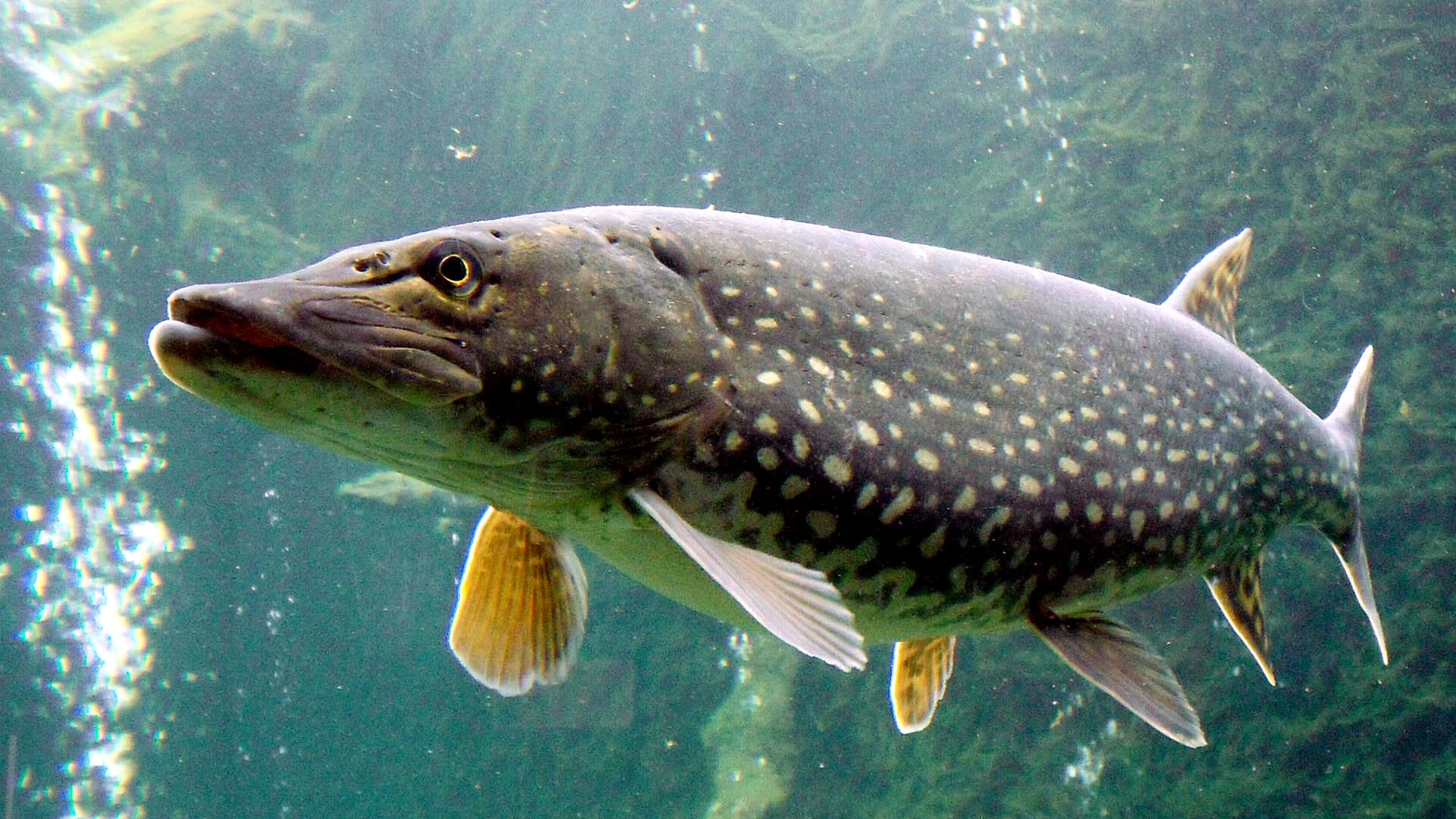
Among the most aggressive freshwater fish, Pikes are commonly found in brackish and freshwater bodies across the Northern Hemisphere.
It has a very slim body, elongated and compressed laterally. It has green-brownish colours on its back with numerous streaks on its sides and a white-silver one on its belly. It has a large head, flattened muzzle, wide mouth, and a dense tooth conformation. It has a twin tail and pectoral fins positioned at the bottom of the body.
Pike can grow to a relatively large size: the average length is about 40–55 cm (16–22 inch), with maximum recorded lengths of up to 150 cm (59 inch) and published weights of 28.4 kg Northern pike are most often olive green, shading from yellow to white along the belly. The flank is marked with short, light bar-like spots and a few to many dark spots on the fins.
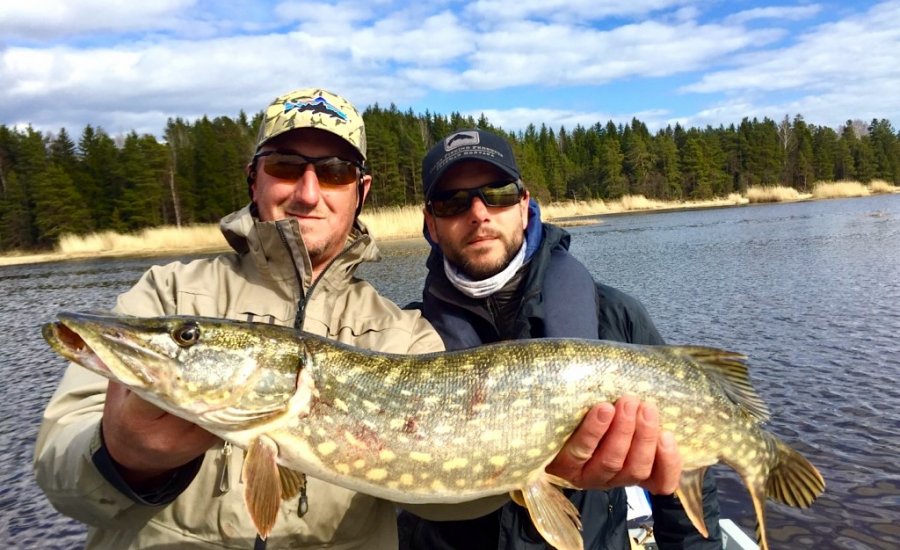
Northern Pike typically live to 10-15 years, but sometimes up to 25 years. In Italy, the newly identified species Esox cisalpinus (“southern pike”) was long thought to be a color variation of the northern pike, but was in 2011 announced to be a species of its own.
Pike are found in sluggish streams and shallow, weedy places in lakes and reservoirs, as well as in cold, clear, rocky waters. They are typical ambush predators; they lie in wait for prey, holding perfect-ly still for long periods, and then exhibit remarkable acceleration as they strike.
The Pike is a very skilled predator that feeds on fish, frogs, crustaceans, birds and small mammals. It does not despise to feed on dead prey or on weak or sick animals, thus contributing to the maintenance of the balance of the ecosystem.